
Convenience decides whether your agent survives month three. IP reputation decides whether your outbound actually lands. The fourth lens is the one your CRO doesn't know to ask about, and the one that kills more agents in production than security failures do.
- §3 · The convenience lens
- §4 · The lens nobody benchmarks, IP reputation
- Local is not magic, the catch
- What actually scales, distributed clean IPs
§3 · The convenience lens
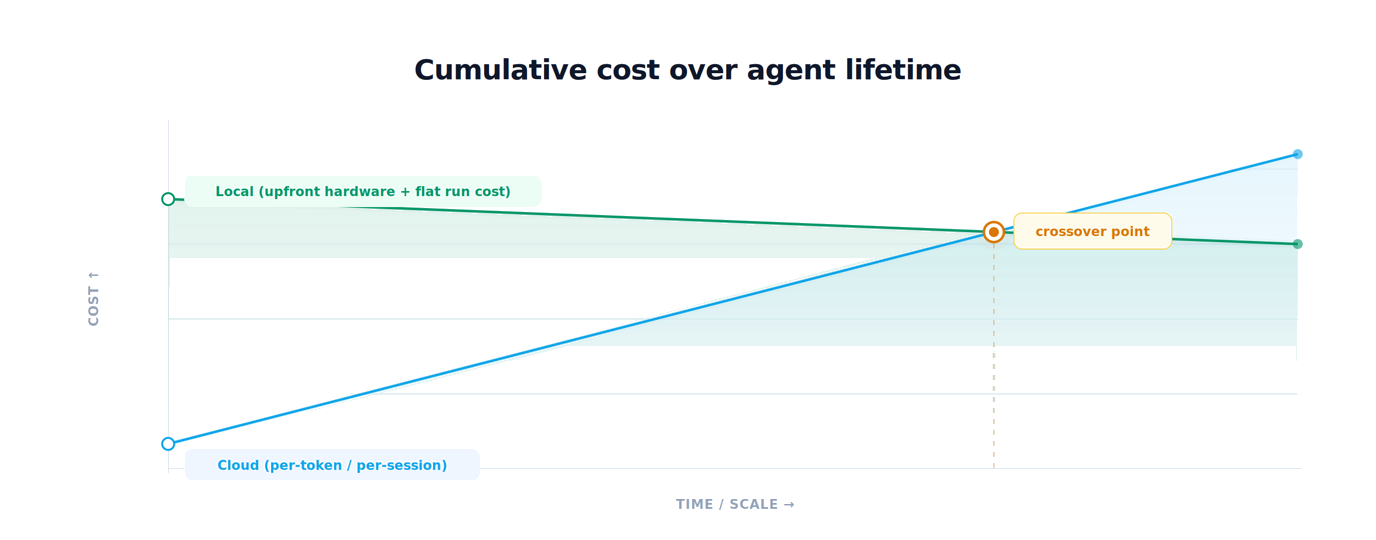
Cloud wins onboarding by a wide margin, paste code, get an isolated runtime, observability included. Solo founders and small teams have no business running their own agent infra in 2026. Local wins TCO at scale, offline operation, and vendor independence. Once a self-hosted setup runs, it keeps running, whether your provider has an outage, deprecates a model, or raises prices.
Keeping it running without a full-time ops team
The stuff that breaks at month three, and how to dodge it.
If you go cloud:
- Budget alerts at 50/80/100%, per-session billing surprises kill projects faster than outages
- Pin model versions in code; opt out of "auto-upgrade to latest" unless you've tested it
- Export prompts + tool definitions to your repo, never let them live only in the vendor's UI
- Multi-vendor abstraction layer (LiteLLM, LangChain) so a Claude price hike isn't an existential event
If you go local:
- Run on dedicated hardware, not a laptop someone closes at 6pm, Mac mini, NUC, or a small on-prem server
- UPS + wired ethernet for the host running anything outbound
- Headless service (systemd, launchd) so the agent restarts after reboot without a human
- Pull model updates on a schedule, stale weights = stale results
- Remote access to the box (Tailscale, WireGuard) so you can debug without driving to the office
Security, performance, convenience, three lenses everyone benchmarks. The fourth is the one your CRO doesn't know to ask about.
§4 · The lens nobody benchmarks, IP reputation
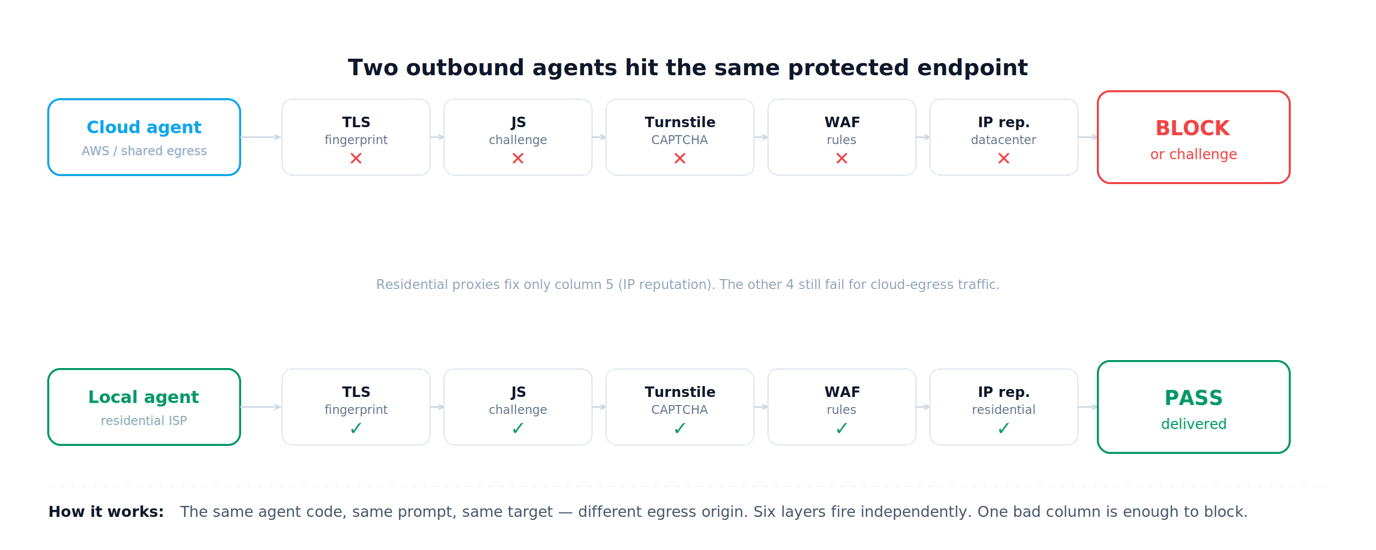
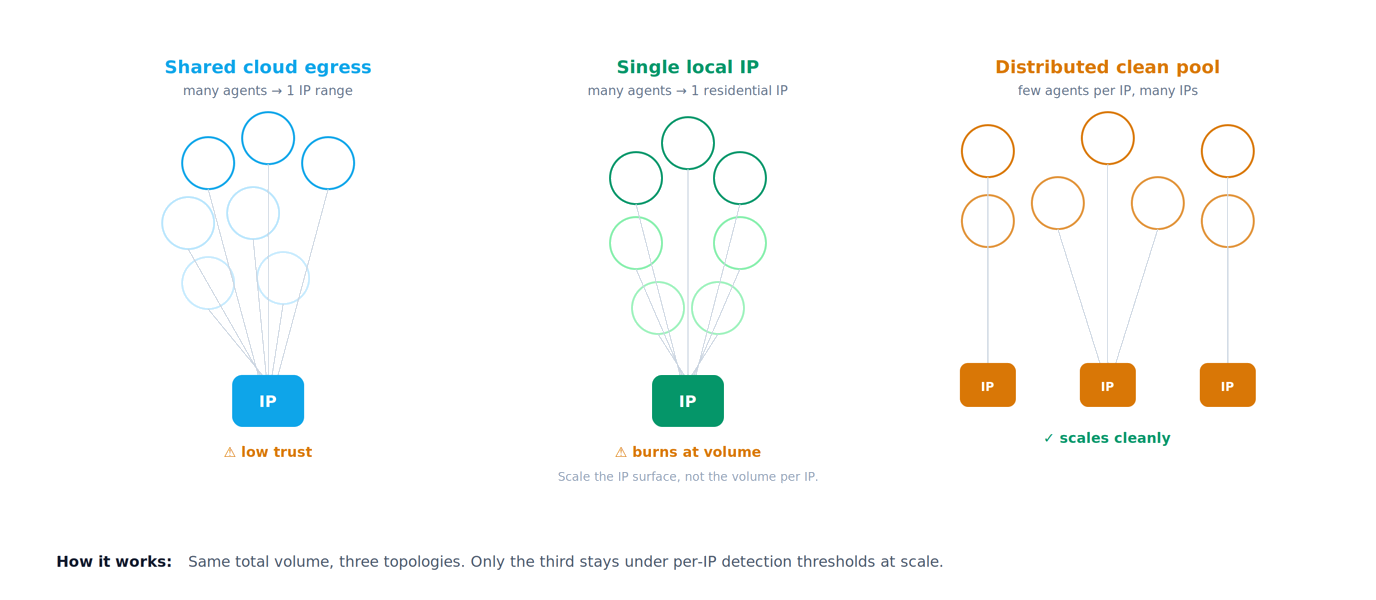
This is the one that decides whether outward-facing agents actually deliver. Cloudflare's 2026 detection stack uses six independent layers: TLS fingerprint, JavaScript challenge, Turnstile, WAF rules, IP reputation, and behavioral analysis. Residential proxies only help with one of those six. AWS / GCP / Azure egress ranges are flagged as datacenter traffic by default, most bot-management vendors score them as low-trust before a single request lands.
What that means in practice: a cloud-hosted scraping agent is fighting a six-layer challenge from the moment it leaves the VPC. A cloud-hosted email-sending agent inherits the deliverability reputation of every other tenant on its shared IPs, one bad actor on AWS SES this morning = your campaign lands in spam this afternoon. A local agent running on the rep's own machine ships from a residential ISP with a clean reputation, real browser fingerprint, real human session history. Detection layers don't fire.
Smartlead's 2026 benchmarks back this. Fully autonomous AI SDRs (typically cloud-hosted, shared infra) get 1–3% reply rates. Hybrid + signal-based outbound (often run from local or single-tenant infra with clean IPs) hits 14–25%. Some of that gap is targeting. A lot of it is reputation.
The catch, local is not magic
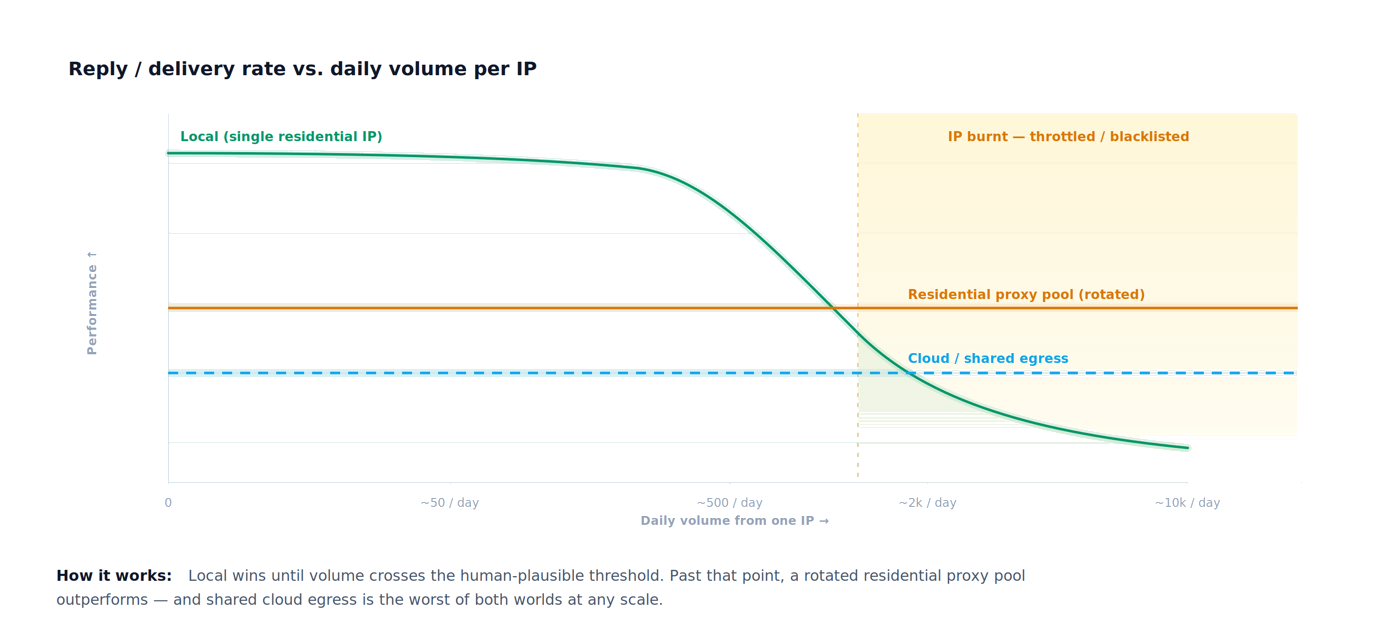
"Local = clean IP" is true at small scale. At volume it inverts fast. A single residential IP firing 5,000 LinkedIn views or 2,000 cold emails per day is a bot signature. ISPs throttle. Mailbox providers blacklist. Cloudflare's behavioral layer detects the spike, same residential IP suddenly browsing 200 unique domains is not a human pattern.
Failure modes for naive local deployment
- Availability ceiling. The agent runs only while the laptop is on, lid open, and the home/office network is up. Close the lid, lose Wi-Fi, kid unplugs the router, the pipeline stops. Cloud agents survive everything except the provider going down.
- One IP, one machine. Whole pipeline depends on a single host staying online. Power cut = outage. No failover.
- ISP acceptable-use policy. Almost every residential ISP contract forbids "commercial use," "automated traffic," "running servers," or volume above an undefined "fair use" cap. Trip the heuristic and your ISP can throttle, send a warning letter, or terminate service. Business-tier contracts are stricter on uptime but looser on automation, and they cost 3–5×.
- CGNAT, you might not have a public IP at all. A growing share of residential and mobile connections sit behind Carrier-Grade NAT. Hundreds or thousands of customers share one external IP. From the outside world your traffic is indistinguishable from a stranger's, and inherits the stranger's reputation. One noisy neighbor on the same CGNAT pool blacklists you by association.
- Volume on a single IP. Residential reputation collapses once volume exceeds human-plausible. Same IP = same score for every account on it.
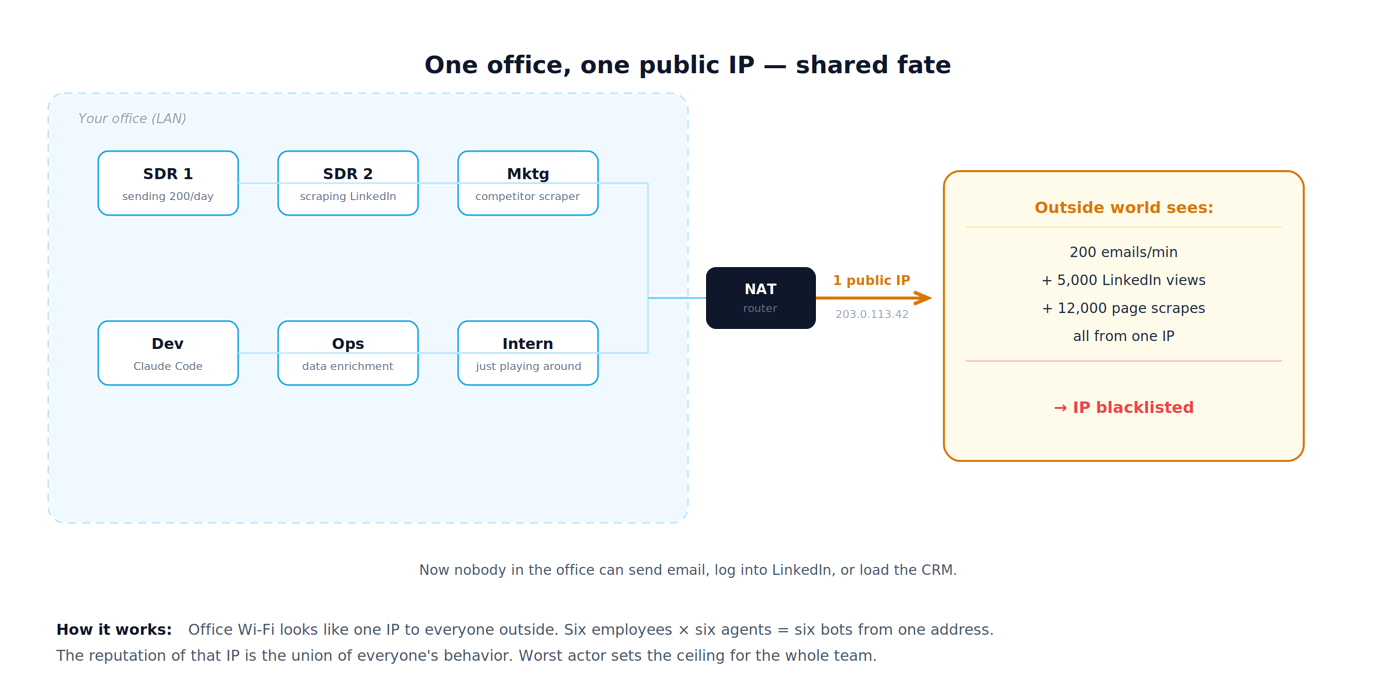
- Shared office network = shared fate. Most offices sit behind a single public IP (NAT). If five reps, two marketers and a curious intern all run agents from their laptops, the outside world sees one IP firing thousands of automated requests. That IP gets blacklisted, and now nobody in the building can send email, log into LinkedIn, or load the CRM.
- No load distribution. Local boxes cannot horizontally scale the way a cloud autoscaling group can. 10× the leads = 10× the wait, not 10× the throughput.
- Geo fixed. Local agent ships from one country. Geo-fenced targets reject it. Cloud can rotate region per request.
- Patching. Browser fingerprint of an outdated Chrome on the rep's laptop becomes the new "bot" signature.
This is the silent risk most teams miss when they enthusiastically tell employees to "just run agents locally." Local was the safe choice, at one user. The moment the office adopts agents broadly, the shared NAT collapses every employee's traffic onto one address, and the building inherits the reputation of its noisiest agent.
Mitigations are real but require thought: per-employee residential proxies, dedicated mailbox infrastructure off the office network, sequencing platforms that enforce per-IP volume caps, or moving the agents to single-tenant cloud egress where each agent gets its own clean IP. "Just run it on your laptop" stops scaling at headcount ≈ 5.
What actually scales
The pattern that works in production isn't "local vs. cloud", it's distributed clean IPs. Three patterns ship today:
- Inbox-per-rep at low volume. Each SDR sends ≤40/day from a dedicated mailbox on a warmed domain. Sub-Dunbar volume, residential-grade reputation.
- Mailbox farms with domain rotation. 20–200 sending domains, 1–3 mailboxes each, sequencing platforms (Smartlead, Instantly) rotate load. Each IP stays under threshold.
- Residential proxy pools for scraping. Bright Data, IPRoyal, Smartproxy, pool of thousands of residential IPs, request-level rotation. Per-IP volume stays human-plausible while aggregate volume hits enterprise scale.
The principle is the same across all three: scale the IP surface, not the volume per IP. Cloud agents fail because they concentrate volume on shared low-trust IPs. Naïve local agents fail because they concentrate volume on a single high-trust IP. The middle path, many high-trust IPs, low volume each, is what actually delivers.
Protecting your IP reputation
BYOIP, dedicated egress, warmup, the operational details that decide deliverability.
If you go cloud:
- BYOIP (Bring Your Own IP). AWS, GCP, and Azure all let you announce your own owned /24 from their infrastructure. Your reputation, not theirs.
- Dedicated egress IPs (NAT Gateway with EIP per tenant) instead of shared egress
- Warmup your sending IPs over 2–4 weeks before any volume, every ESP and Cloudflare expects a ramp
- Route outbound traffic through a managed proxy service (Bright Data, Oxylabs) with rotation per request
- SPF / DKIM / DMARC on every sending domain; PTR records pointing back to your domain on every IP
- Monitor blocklists (Spamhaus, Barracuda, SURBL) continuously, not after the campaign tanks
If you go local:
- Business-tier ISP contract with a static IP and written permission for automated traffic, residential AUPs do not cover this
- Avoid CGNAT, confirm your connection has a real public IPv4 before counting on local reputation
- Route outbound through your own VPS / proxy with a clean static IP if the office IP is shared
- Per-employee mailbox infrastructure off the office network (warmed domains, sequencing platform)
- Per-IP volume caps in the agent itself, never let one box exceed human-plausible rate
- Office firewall rule: block direct outbound to LinkedIn / SES / scraped targets, force traffic through approved proxies so no rogue laptop burns the building IP.