Verified access for agents.
Settlement for the web.
Your agents reach the open web with an identity they can prove. The destinations they read get recognized, and paid.
- Receiptrcpt_4c7d
- Agentagt_7f2a · crawler-eu
- Destinationapi.example.com
- Regioneu-central
- Web Bot Authsignature valid
- Route originAS64500 · ROA valid
- Content hashsha256:9f2b…e0c7
- Transactiontxn_9a21
The web stopped trusting unidentified traffic.
Enforcement, gatekeeper defaults and payment networks moved to verified identity within twelve months. Not a forecast. A record.
The FBI and industry partners seized hundreds of domains tied to a residential proxy network allegedly built on two million compromised devices.
Read the coverage →Cloudflare now validates Web Bot Auth natively: verified AI agents allowed by default, unidentified ones blocked.
Read the docs →Visa TAP and Mastercard Agent Pay adopted Web Bot Auth for agentic commerce. The identity that opens a gate now lets an agent pay.
Announcement →What got seized is not what we built.
The seized networks share a design: unidentified operators, hijacked consumer devices, no one to call. Metro Fabric is the inverse by construction:
Identify. Sign. Settle.
One accountable path from your agent to the destination. Each request carries a verifiable identity, produces a signed receipt, and settles with the site it reached.
Each agent egresses with a verified network identity, real ASN, geolocation and route origin. No borrowed addresses, no disguise.
Every request is cryptographically signed and produces a receipt: who called, what they reached, from where. Tamper-evident and attributable.
Verified demand is metered in tokens, and the destinations your agents read are recognized and paid for the access.
Destinations recognize a verified caller and let it through, instead of blocking it. Access that holds, run after run.
Built for AI operators. Made viable by publishers and carriers.
Production agents, past the gate.
Whatever your agents automate, marketing operations, research, ERP and CRM workflows, customer-facing AI, this is the egress and identity layer that gets them through.
- Verified-edge egress that passes the gate
- One credential for every destination
- A signed access record per request
Visibility on AI traffic, not just blocks.
Verified AI traffic carries a signed identity credential, so you can see it, price it, and settle for it instead of only blocking it.
- Recognise verified AI traffic on sight
- Cut spend on bot defense
- A signed record for every access
The partner that anchors trust.
Not a buyer of the fabric, the rails it runs on. Under-used local capacity becomes the identity layer of the agentic web, and we bring the demand.
- Monetise under-used capacity
- Anchor the agentic web's identity layer
- We bring the demand
Built on open standards.
No proprietary protocol to adopt. Metro Fabric speaks what your agents and the internet already speak.
Verifiable bot identity. IETF draft.
HTTP message signatures on every request.
Rotating per-operator signing keys.
Route-authorized origin, so every request is provably from a verified network.
Verified agents get through. Unidentified bots get blocked.
More of the web now blocks automated traffic it cannot identify. Metro Fabric gives every agent a verifiable identity and a signed, accountable route, so it arrives recognized and allowed, not blocked.
Evasion has a cost curve. Verification doesn't.
Retries, solver spend, ban cycles, pool churn and legal exposure all scale with volume. A verified identity is one line in a request header. Metro Fabric runs alongside your existing stack: move the targets that matter first.
Get recognized, and paid.
The other side of the network. An owner that recognizes a verified agent can charge it for access, and Metro Fabric settles automatically. Recognized agents get in; unidentified ones are turned away.
The more it's used, the more it settles.
Every accountable request tells the network, in aggregate, which destinations matter. That signal is how Metro Fabric decides who to settle with next.
More agents and more verified requests flow through the network.
In aggregate, and only with consent, the network sees which destinations matter most.
Metro Fabric signs the destinations the demand points to, one after another.
Settled access now works on more of the web, which pulls in more usage.
The demand signal is only ever aggregate and opt-in. The network sees which destinations are busy, never who visited them.
Every request stands behind a real, named operator.
Every operator is identity-verified before an agent can egress.
A real, reachable contact stands behind the traffic, not an anonymous pool.
Requests leave from a real, declared location with attributable geo.
Every request is signed and logged, so both sides keep a verifiable record.
Notes on running agents accountably.

The playbook –what this looks like for your company
There is no universal answer to where AI agents should run. The right deployment depends on the workload, security requirements, scale, and business context – and for most organizations, the answer is hybrid.
Read more →
When local isn't a choice – it's the only option
Some AI agents can't run in the cloud. Internal systems, legacy software, and regulatory requirements often make local deployment the only viable option.
Read more →
Convenience & IP reputation – the lens nobody benchmarks
Convenience keeps AI agents running in production. IP reputation determines whether their outbound activity actually gets through.
Read more →
Security & Performance – the two lenses everyone benchmarks
Cloud or local? The answer shapes an AI agent's security, speed, and cost. This article explores the tradeoffs and practical ways to optimize both.
Read more →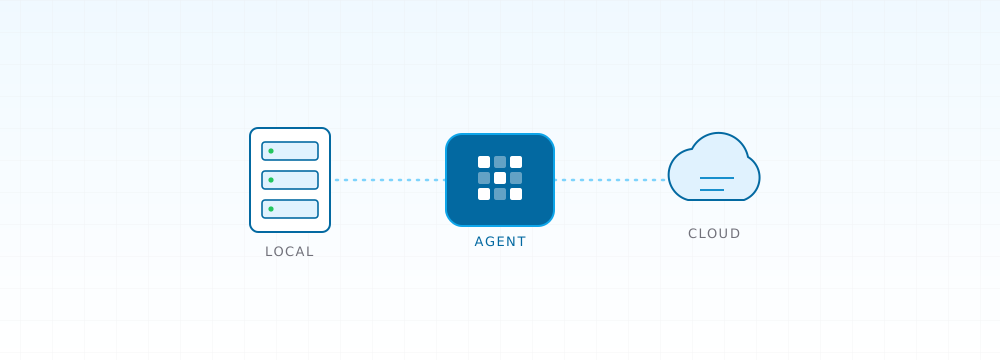
Where do your AI agents actually run?
Most AI discussions focus on models and capabilities, but deployment location often has a bigger impact on cost, security, compliance, and performance. This article explores where AI agents actually run and why the simple "local vs. cloud" debate misses the bigger picture.
Read more →
What is an AI agent? And how is it different from a proxy?
What makes an AI agent different from a chatbot, workflow, or API call? It all comes down to one thing: the ability to observe, decide, and adapt through a feedback loop.
Read more →Join the waiting list.
Metro Fabric is onboarding its first builders and destinations. Leave your email and we will be in touch.
Something went wrong. Please try again in a moment.
You're on the list.
Thanks for joining. We will be in touch soon.