
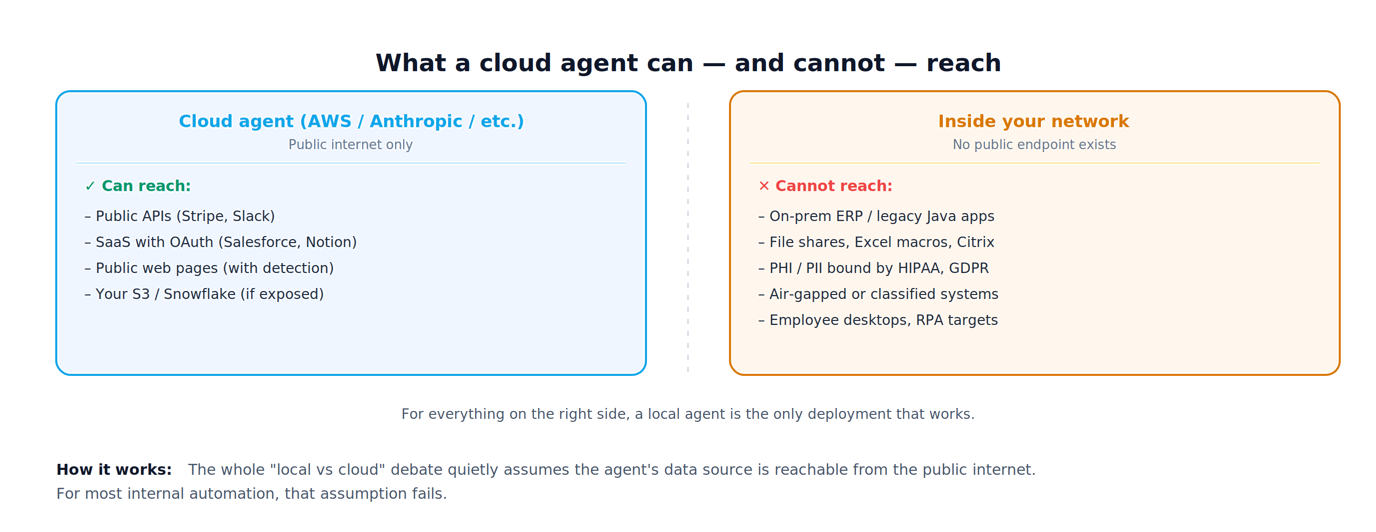
For RPA, internal automation, and any regulated workload, cloud isn't a tradeoff, it's structurally impossible. The on-prem ERP, the legacy Java app, the patient data, the classified system, none of them have a public endpoint, and they shouldn't.
- RPA and internal automation can't reach into the cloud
- Regulation often forecloses cloud entirely
- Making mandatory-local actually work
The previous parts framed local mostly as a reputation play for outbound traffic. That's only one slice of the agent world. A big chunk of real production deployments are internal, and for those, cloud isn't a tradeoff, it's structurally impossible.
RPA and internal automation can't reach into the cloud
The agent that reconciles invoices in your on-prem ERP, moves files between two desktops in the accounting department, fills in fields in a 1998-vintage Java application that has no API, or watches a network share for new PDFs and drops them into SharePoint, that agent has to physically run inside the network where those systems live. The data sources don't have public endpoints. Even if they did, opening them up would defeat the security model that put them on-prem in the first place.
This is the entire reason UiPath, Automation Anywhere, and Blue Prism shipped on-prem orchestrators a decade ago. AI agents now have the same constraint, only with stronger reasoning attached. A cloud agent can't open the legacy Citrix session, can't read the local Excel file with the macro, can't drive the desktop app that the finance team uses every morning. A local agent can.
Regulation often forecloses cloud entirely
For a meaningful slice of the economy, "deploy it in AWS" is not a legal option:
- Healthcare (HIPAA, EU MDR, NHS DSP). Patient data can leave the hospital only under tightly-defined BAAs. Many systems forbid US-hosted inference entirely; EU sovereignty rules push toward on-prem or sovereign-cloud only.
- Financial services (PCI-DSS, MiFID II, FFIEC, DORA). Trading systems, KYC pipelines, and core banking can't expose data to a third-party LLM provider without explicit auditor sign-off, which most cloud agent platforms don't yet have.
- Government & defense (FedRAMP High, IL5, NATO classifications). Most public agent platforms don't hold the clearances. Anything touching classified or controlled-unclassified information runs in air-gapped environments by default.
- EU AI Act (in force Aug 2026). "High-risk" AI systems carry recordkeeping, human-oversight, and data-governance requirements that cloud-only deployments struggle to satisfy, especially when the model provider is non-EU.
- Sectoral data-residency laws. Germany, France, China, India, Saudi Arabia, Brazil all have rules that effectively pin certain workloads inside national borders. Generic US-hosted Claude or GPT isn't a path forward there.
For internal automation and regulated workloads, "local" isn't a reputation strategy. It's the only deployment that ships.
Making mandatory-local actually work
When cloud isn't on the table, the discipline shifts to network design and audit. The hard part isn't running the model, small open-weight models on a workstation are well-understood in 2026. The hard part is governance: who can call which tool, what gets logged, who reviews destructive actions, how the regulator sees it.
Two patterns that actually work:
RPA / internal automation
- Run agents on a dedicated VM inside the same network segment as the target systems
- Use service accounts with least-privilege, not human credentials
- Pair a small local model for sensitive steps + cloud frontier model only for reasoning that genuinely needs it (with PII stripped before the call)
- Treat the agent like an RPA bot, record what it did, gate destructive actions behind human approval
- Network-level isolation: the agent VM has only the routes it needs, nothing more
Regulated industries
- Sovereign cloud or air-gapped on-prem, confirm provider holds the right certifications (BAA, FedRAMP, IL5) before designing
- Self-hosted open-source models (Llama 3, Mistral, Qwen) on hardware you own, no inference call leaves the perimeter
- Document data flows for the regulator before you ship, not after audit
- For EU AI Act "high-risk" systems: human-in-the-loop checkpoints, full audit log, written model card
- Quarterly model-card refresh with bias/fairness eval, regulators are starting to ask