
Six archetypes by company size and footprint. Concrete recommendations. The decision matrix by workload. And the three-sentence rule worth tattooing on your AI strategy.
- §6 · What this looks like for your company
- §7 · The verdict, pick by job, not by company
§6 · What this looks like for your company
The right answer depends on two axes most often: how big you are, and where your customers and data live. Six rough archetypes, with the deployment patterns that actually ship.
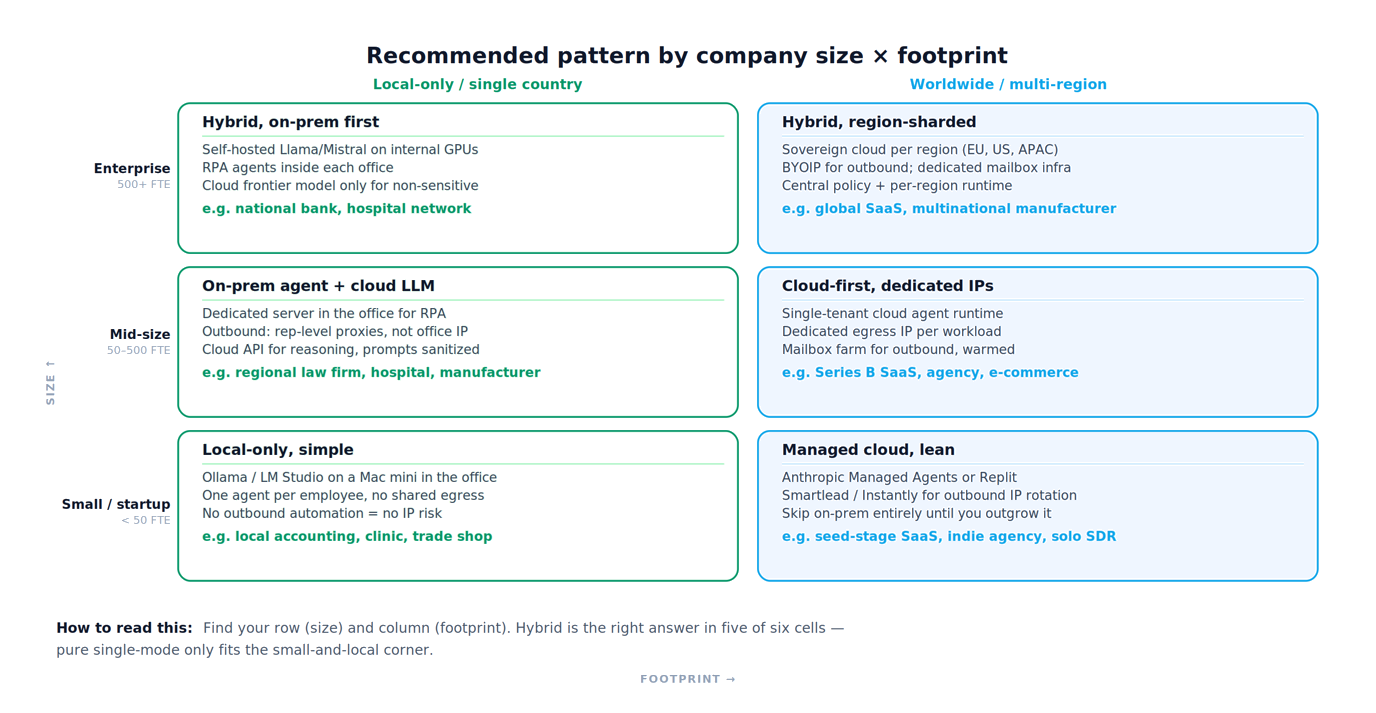
Small & local-only (clinic, accounting firm, single-office trade)
Run open-source LLMs (Llama 3 8B, Mistral) on a Mac mini or a small workstation in the office. One agent per employee for internal tasks, document drafting, data entry, calendar management. Don't do outbound automation from the office IP unless you've thought about CGNAT and AUPs first. Use a SaaS tool (Smartlead, HubSpot) for any cold email so the reputation risk is theirs, not yours.
Small & worldwide (seed-stage SaaS, remote agency, solo SDR)
Skip on-prem entirely. Anthropic Managed Agents or Replit Agent for orchestration. For outbound, use a sequencing platform that handles mailbox rotation and IP warmup for you (Smartlead, Instantly, Lemlist). Your competitive advantage is iteration speed, don't sink it into infrastructure ops.
Mid-size & local (regional law firm, hospital, manufacturer)
Dedicated server in the office for RPA and internal agents, this is where the legacy systems live and the data can't move. Cloud API for the reasoning layer, but sanitize prompts (strip PII before it leaves the building). For outbound communications, use rep-level dedicated proxies or mailbox infrastructure, never the office IP. Budget ~€20–40k/year for hardware + ops.
Mid-size & worldwide (Series B SaaS, growth-stage e-commerce, modern agency)
Single-tenant cloud agent runtime in your VPC. Dedicated egress IPs (NAT Gateway + EIP per workload). Mailbox farm with 20–100 sending domains, warmed over weeks. BYOIP for any high-volume scraping where reputation matters. Cost is real (~€8–15k/month) but predictable.
Enterprise & local-only or regulated (bank, hospital network, government)
Self-hosted open-source models on internal GPU infrastructure, no inference call leaves the perimeter. RPA agents in each office, orchestrated centrally. Cloud frontier model allowed only for non-sensitive, non-customer-data workloads, with explicit audit trail. Expect a 12–24-month rollout, an internal AI governance committee, and a written model registry.
Enterprise & worldwide (multinational SaaS, global manufacturer, payments)
Region-sharded sovereign-cloud deployment, EU runs in EU (Anthropic on AWS Frankfurt, or sovereign provider), US in US, APAC in APAC. Central policy plane, per-region runtime. BYOIP across all egress, with a dedicated email reputation team. Multi-vendor LLM abstraction so a single provider's outage doesn't shut down global ops. Most expensive pattern, and the only one that survives a Tier-1 audit.
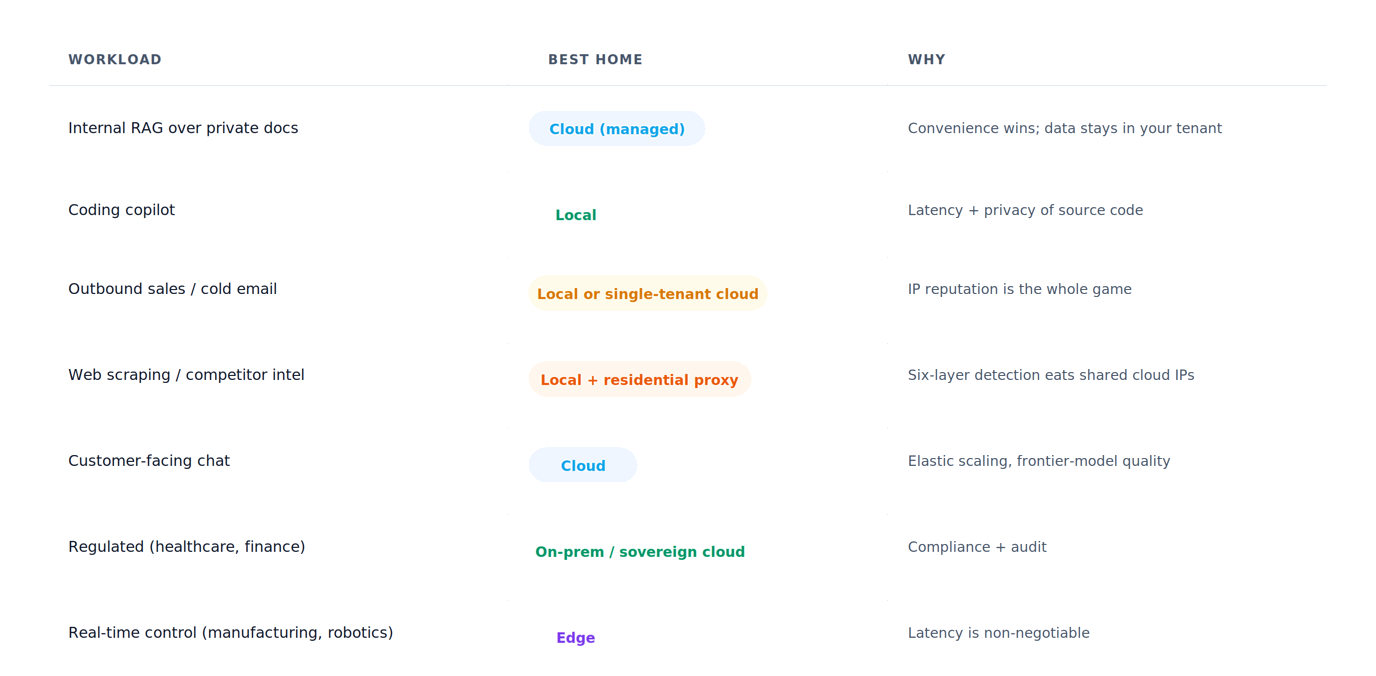
§7 · The verdict, pick by job, not by company
Don't pick local or cloud. Pick by job.
The hybrid story isn't a transition. It's the destination. The teams that win in 2026 are the ones who treat "where the agent runs" as a first-class architectural decision, not an afterthought that surfaces the day Cloudflare starts blocking their traffic, the regulator asks where the data went, or the AWS bill triples.
The three-sentence rule
If you remember nothing else from this whole series, remember this:
- Cloud agents are cheap until they're not. They scale onboarding and quality; they break on reputation, sovereignty, and unit cost.
- Local agents are clean until they're loud. They scale privacy and latency; they break on availability, ISP policy, and shared-IP pile-ups.
- Hybrid isn't a phase, it's the answer. Different layers, software, network, infrastructure, can live in different places. The mix is the design.
If your agent talks to the outside world, where it ships from matters as much as what it says. If your agent talks to inside the building, where it ships from is the only thing that matters.
We opened Part 1 with a question, most teams pick where their agents run by accident. The teams that stop picking by accident, and start picking per workload, are the ones whose Q3 numbers don't quietly collapse.
Thanks for following the series. If any single piece changed how you think about a workload you're shipping right now, that was the whole point. The agents that win in 2026 aren't the smartest, they're the ones deployed in the right place, on the right network, for the right job.
Sources across the series
- Grand View Research, AI Agents Market Report (2026)
- Gartner, Enterprise AI Agent Adoption Forecast (Aug 2025)
- Zenity, Enterprise AI Agent Security Report (2026)
- Cloud Security Alliance, State of Cloud & AI Security (Mar 2026)
- Smartlead / Landbase, AI SDR Benchmark Data (2026)
- Cloudflare, Bot Detection Architecture (2026 update)
- Anthropic, Managed Agents Pricing (Apr 2026)
- Prelude Security, Local AI Agent Risk Inventory (2026)
- NVIDIA Research, "Small Language Models Are the Future of Agentic AI" (2025)
- HuggingFace, Open-Weight Model Hardware Requirements (2026)